
Cypress and the Golden Nocturne: Van Gogh’s Celestial Motion & Rhythm
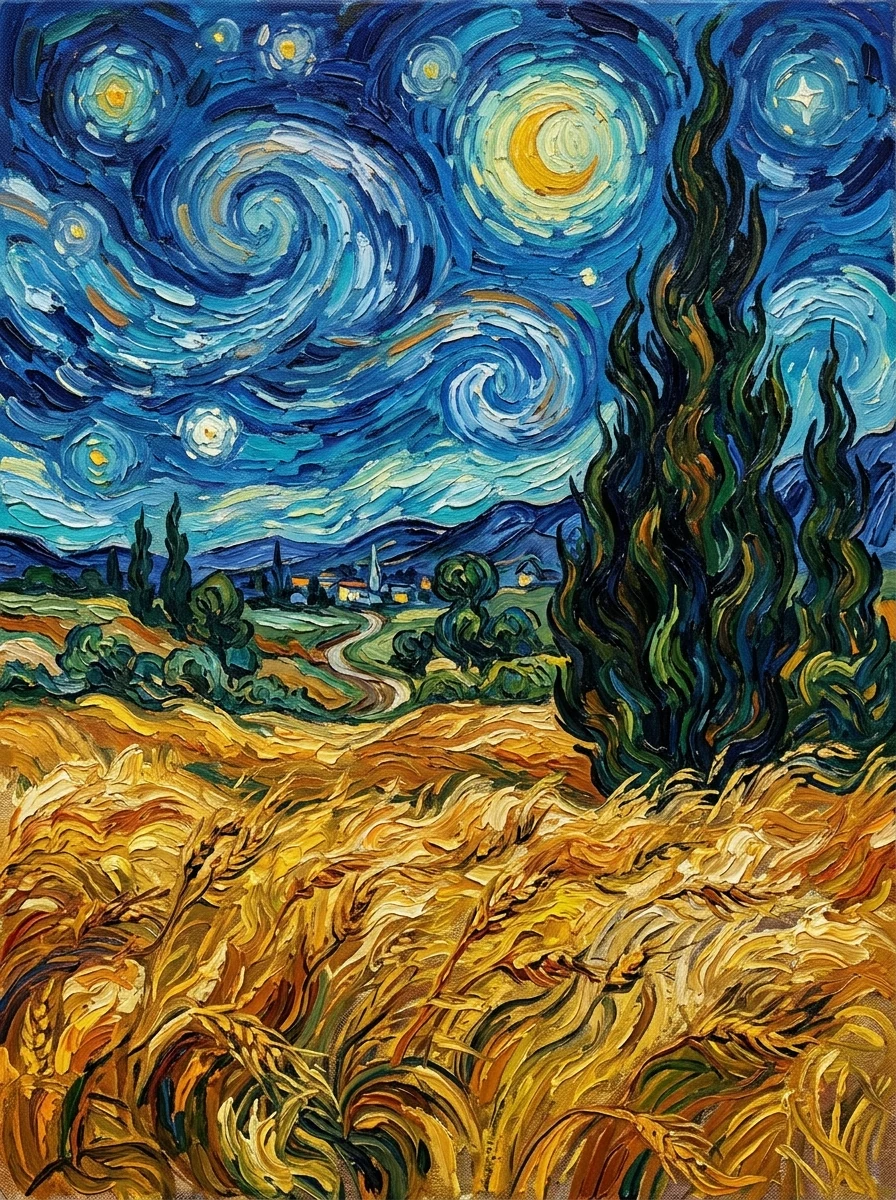
Whirling cobalt heavens and flame-like cypresses above ripe golden wheat.
The Cypress as Cosmic Conduit
In the summer of 1889, while gazing out at the Alpilles mountains from Saint-Rémy-de-Provence, Vincent van Gogh became consumed by the dark, vertical silhouettes of cypress trees. He described them in letters to his brother Theo as "beautiful as an Egyptian obelisk," connecting the fertile earth below with the swirling infinity of the night sky above.
In "Cypress and the Golden Nocturne," the cypress rises like an emerald flame against undulating ribbons of deep Prussian and cobalt blue, while the ripe golden wheat below ripples with rhythmic brushwork.
“I often think that the night is more alive and more richly colored than the day.” — Vincent van Gogh
Tactile Brushwork, Seen Up Close
The essence of Post-Impressionist power lies in its sculptural surface. Paint was applied directly from the tube or with a vigorous palette knife, creating ridges that catch light dynamically across the room.
Standing before the original, every micro-peak and ridge shows the movement of the painter’s hand, a vitality that photographs can only hint at.
Styling with Impressionist Energy
This artwork injects dynamic warmth into dining rooms, airy living spaces, or modern rustic interiors. The contrast of golden ochre and nocturnal cobalt commands attention in both natural and low evening lighting.